
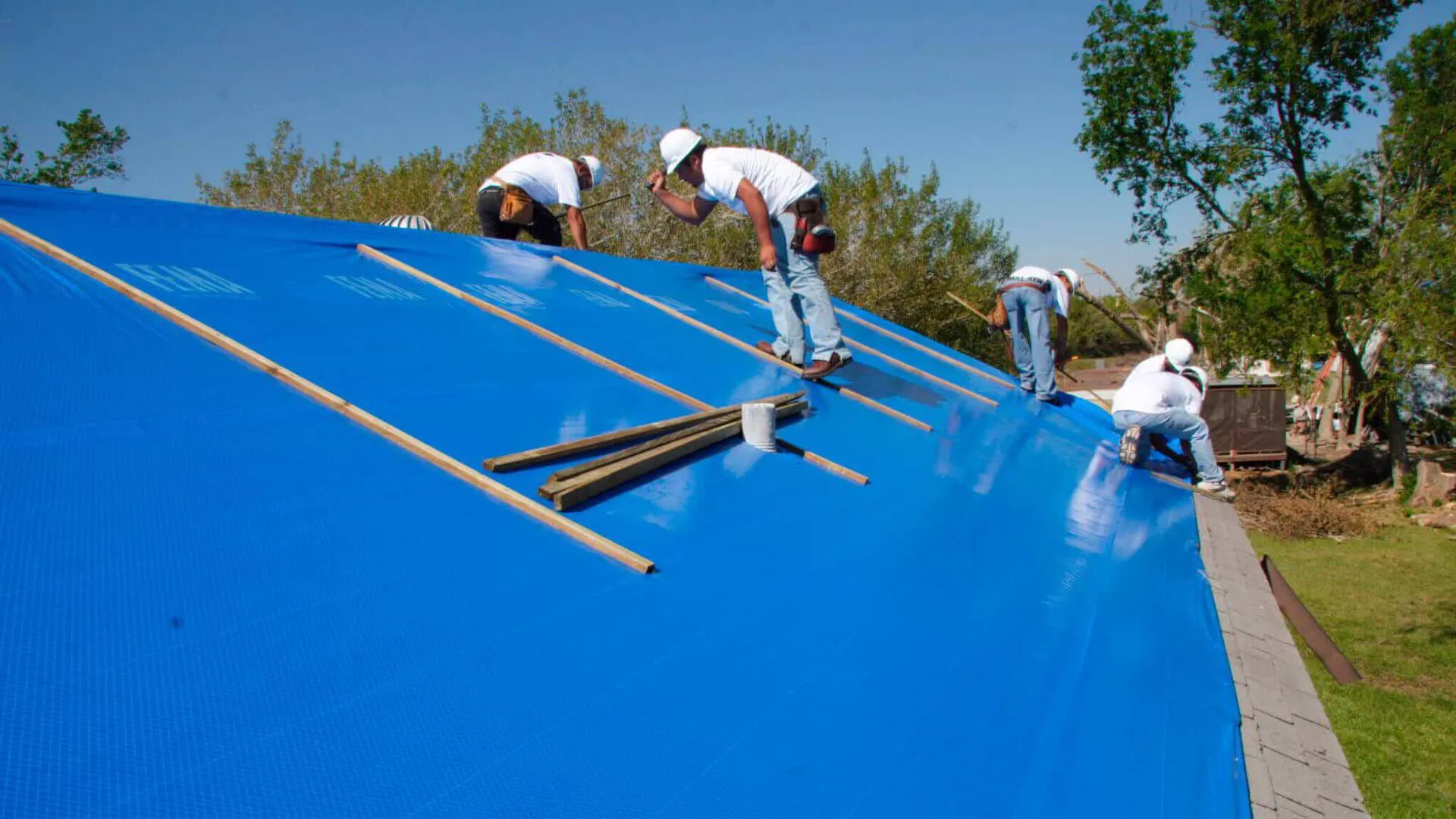
Central Iowa's severe-weather season runs on straight-line wind and fast-moving thunderstorm lines as much as it does on hail. A derecho or a strong squall line can put gusts well past a roof membrane's design uplift resistance in a matter of minutes, and the damage it leaves behind ranges from an obviously torn membrane to a much quieter loss of adhesion that will not fail completely until the next storm finishes the job.
Wind damage on a low-slope roof concentrates at the edges and corners, which is exactly where wind uplift pressure is highest by design. We start every wind-related inspection at the perimeter: coping caps, gravel stops, gutters, and the membrane's terminated edge. A lifted or torn edge here is often the first sign the field membrane is under more stress than it looks like from a ground-level walk of the building.
Rooftop equipment is a frequent casualty of straight-line wind events and one of the easiest things for an owner to overlook. HVAC units can shift on their curbs, condenser fins can be bent by debris, and lightweight equipment - vent covers, small exhaust fans, satellite mounts - can be torn loose entirely. We photograph and log equipment condition on every wind inspection, because a unit that has shifted off its gasketed curb can be causing a leak long before anyone connects it to the storm that moved it.
Ballasted roofs carry their own wind exposure. Loose stone ballast can migrate toward parapets and drains during high wind, exposing membrane that was never meant to see direct UV or foot traffic, and can also damage the membrane itself as it scours across the surface. We document ballast displacement patterns and check drains for stone blockage as part of any post-storm inspection on a ballasted system.
The distribution and warehouse buildings that have grown up along I-80 and I-35 near Altoona, Ankeny, and Bondurant tend to have long, unbroken roof runs with a lot of perimeter length relative to their footprint, which means more linear feet of edge detail exposed to wind uplift. A single failed section of edge metal on a roof that size can let a storm get underneath the membrane along a much longer run than the same failure would affect on a smaller building.
Downtown and skywalk-connected office towers face a different wind exposure: taller buildings funnel and accelerate wind around parapets, penthouse structures, and rooftop mechanical screens in ways that a single-story building never experiences. We look closely at parapet flashing, mechanical screen anchorage, and roof-level signage mounts on taller downtown buildings, since these details take wind loading that a standard field inspection can miss if it only looks at the open membrane field.
We document the wind event itself alongside the roof condition - general storm timing from public weather sources, wind direction if it's discernible from the damage pattern, and how the damage lines up with known storm paths through the metro. That context helps an adjuster connect a specific loss to a specific event rather than treating storm damage as generic wear.
Interior signs often surface before anyone gets on the roof. A water stain near an exterior wall, a door that suddenly binds, or a change in how a rooftop unit sounds can all point back to a wind event days or weeks earlier. When an owner calls about an interior symptom, we start the roof inspection by tracing that symptom back to the roof area most likely to be affected, then expand the inspection from there.
Wind claims get underpaid most often when the documentation stops at the obvious damage and doesn't capture the adjacent field that was compromised but hasn't visibly failed yet. A membrane section next to a torn edge may have lost adhesion without tearing, and that section will fail on its own timeline if it isn't included in the current scope. We test adjacent field areas near any wind-damaged edge for this reason, beyond just the section that is visibly torn.
We're your roofing contractor, not a public adjuster - we document and substantiate the wind and storm damage so you and your adjuster work from an accurate, complete scope.
What wind damage often looks like from the roof
Lifted or torn membrane at the perimeter, missing or bent coping caps, displaced ballast, and rooftop units shifted or unbolted from their curbs. Interior signs - a stain near an exterior wall, a door that suddenly won't seal - often show up before anyone climbs the ladder.
Questions Owners Ask
Where does wind damage usually start on a flat commercial roof?
At the perimeter - coping, gravel stops, and the membrane's terminated edge - because that's where uplift pressure concentrates. We inspect edges and corners first on every wind-related visit.
Can wind damage a roof without tearing the membrane?
Yes. Wind can loosen adhesion or fasteners without a visible tear, which is why we test the field near any damaged edge, not only the section that has already failed.
Does storm wind damage rooftop equipment?
Often. HVAC units can shift on curbs, lightweight equipment can be torn loose, and condenser coils can be bent by wind-driven debris. We inspect and document equipment on every storm-related visit.
How do you connect roof damage to a specific storm?
We document the roof condition alongside general storm timing and direction from public weather sources, which helps an adjuster tie a specific loss to a specific event.
What if we only noticed a leak days after the storm?
That's common, especially with edge or equipment damage that takes time to show up inside. We trace the interior symptom back to the likely roof area and inspect from there.
Related Roof Work
Commercial Roof Insurance Claims
Hail Damage Roof Insurance Claims