
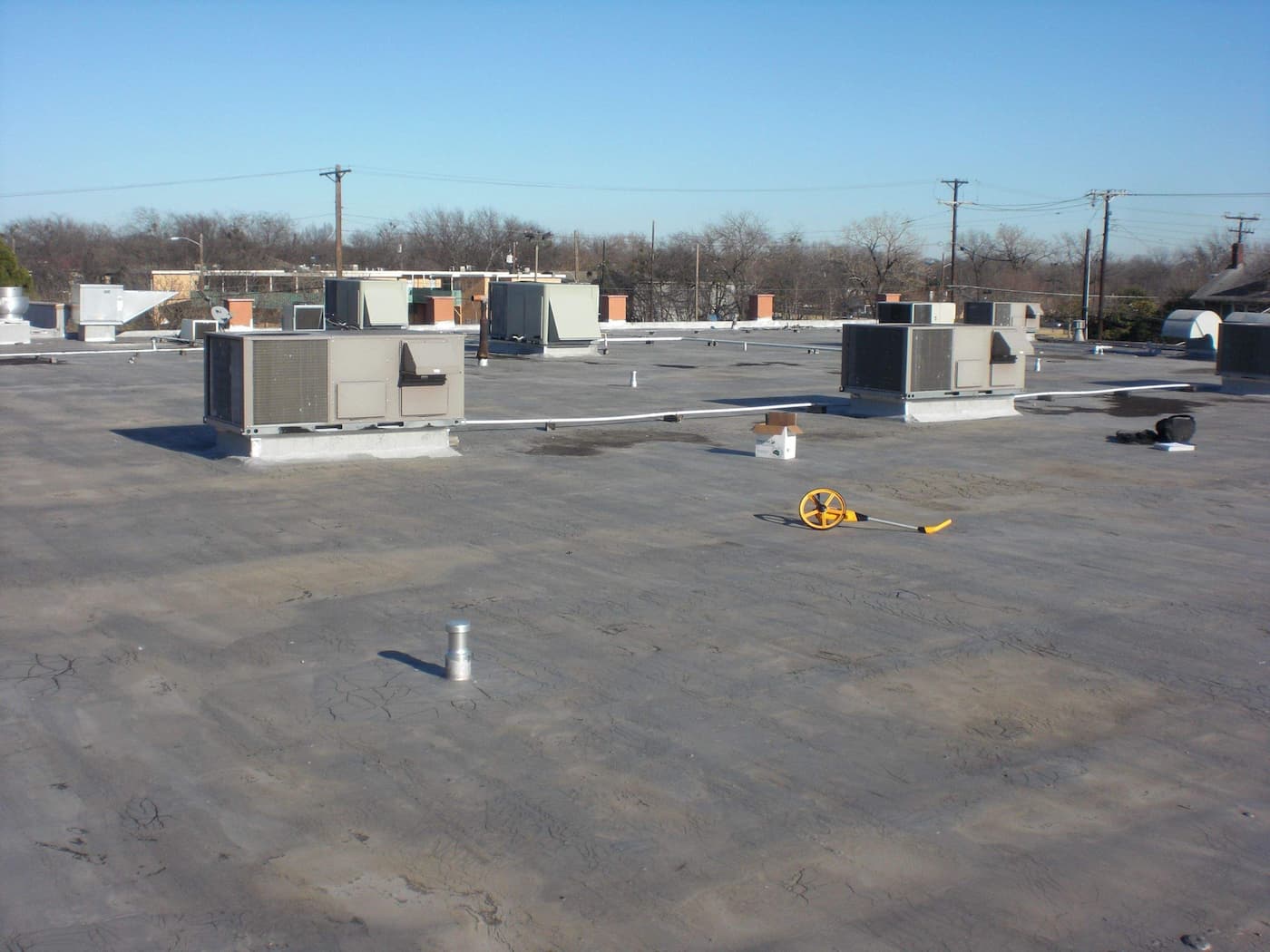
Central Iowa sits inside what meteorologists call hail alley, and Des Moines commercial roofs take that seriously every storm season. A hailstorm that barely dents a car hood can still crack the surfacing on a modified bitumen roof, bruise the membrane on a TPO or EPDM system, or knock granules loose across a wide field - damage that is easy to see from the ground on a vehicle and almost invisible from the ground on a roof.
Hail damage on a low-slope commercial roof does not announce itself the way it does on a shingle roof. There is no missing shingle, no obvious streak. Instead there is bruising - soft spots in the membrane where the mat is fractured but the surface still looks intact - and it takes a hands-on inspection with a moisture meter and a trained eye to find the pattern across a full roof field rather than a single test square.
Our hail inspections start with test squares laid out in a grid across the roof, rather than only at the spots that look worst from the hatch. We count and mark hits per square, check rooftop units, curbs, and vent stacks for dents and cracked seals, and look at edge metal, coping, and gutters for hail damage that is often more visible than membrane bruising because the metal dents where the membrane just compresses.
Warehouse and distribution roofs along the I-80/I-35 corridor around Altoona, Ankeny, and Bondurant carry some of the largest single-field exposure to hail in the metro. A big single-ply roof on a distribution building can look fine from the parking lot after a storm and still have thousands of square feet of bruised membrane that will fail early if it is not documented and addressed. We walk the full field on these roofs, not a sample, because a partial inspection on a roof this size tends to undercount the damage by a wide margin.
Office campuses in West Des Moines, Clive, and Waukee - a lot of it insurance and financial-services space - present a different problem: tenant-occupied buildings where roof access has to be scheduled around business hours, and where a hail claim often gets noticed only after a leak shows up inside, well after the storm that caused it. We can document hail damage weeks or months after the event, comparing membrane condition against known storm dates from public weather records to help establish when the damage occurred.
We do not tell an owner how much their claim is worth, and we do not promise a specific outcome. What our test-square documentation gives an adjuster is a defensible sample: how many hail hits per square foot, how consistent the pattern is across the roof, and whether the damage functionally impairs the membrane, versus cosmetic marking that would not be a covered repair. That distinction matters, and it is easiest to make with photos and counts rather than a description after the fact.
Metal roofing and edge details take hail differently than membrane. R-panel and standing-seam roofs show hail as visible dents in the panel field, and those dents are often the clearest, least arguable evidence on the whole roof. We photograph dent patterns on metal roofing, coping caps, and gutters at multiple angles and distances, since dent visibility changes with light angle and can be missed in a single photo.
Rooftop equipment is easy to overlook in a hail claim and expensive to leave out. Condenser coils, curb caps, and exhaust hoods can take hail damage that affects performance even when the roof membrane around them is fine. We check and photograph rooftop units as part of every hail inspection, not as an afterthought, because equipment damage that gets missed at the time of the claim is much harder to attach to the same storm event later.
A hail claim that gets denied is usually denied on the strength of the documentation, not the strength of the storm. We have gone back to roofs where an earlier inspection found "cosmetic" damage in a handful of squares and, on a full-field re-inspection, found functional bruising spread well beyond what was first sampled. When that happens, we rebuild the documentation from scratch and hand the owner an accurate record to bring back to the adjuster.
Timing the roof walk matters in hail season specifically. Hail bruising can be harder to detect if a membrane has had weeks of sun and thermal cycling to partially reseal small punctures, so the sooner we can get on a roof after a suspected hail event, the more reliable the test-square count. We prioritize hail-related inspection requests during and immediately after storm season for that reason.
We're your roofing contractor, not a public adjuster - we document and substantiate the hail damage so you and your adjuster work from an accurate, roof-wide scope.
What we bring to a hail inspection
A moisture meter, chalk or paint markers for test squares, a ladder or lift for edge metal and rooftop units, and a camera set up to log location and time on every photo. The goal is a file the adjuster can follow without a site visit of their own.
Questions Owners Ask
How is hail damage on a flat commercial roof different from a shingle roof?
Flat commercial membranes bruise rather than crack visibly, so the damage is often invisible from the ground. We use test squares and a moisture meter to find and count hail hits across the roof field.
How soon after a hailstorm should the roof be inspected?
As soon as it's safe to access the roof. Bruised membrane can partially reseal with sun exposure over time, which makes hits harder to count accurately the longer an inspection is delayed.
What is a test square and why does it matter for a hail claim?
A test square is a marked sample area used to count hail hits per square foot. Adjusters use test-square data to judge whether damage is widespread enough to warrant a larger repair or replacement scope.
Can hail damage be cosmetic instead of a covered loss?
Some hail marking is surface-level and doesn't affect performance, which insurers may treat differently than functional membrane damage. We document both so the distinction is based on evidence, not description.
Does hail damage rooftop equipment as well as the membrane?
Yes. Condensers, curb caps, and exhaust hoods can be dented or have damaged coils. We inspect and photograph rooftop equipment as part of every hail claim documentation visit.
Related Roof Work
Commercial Roof Insurance Claims
Wind and Storm Damage Roof Insurance Claims
Acrylic and Silicone Roof Coatings