
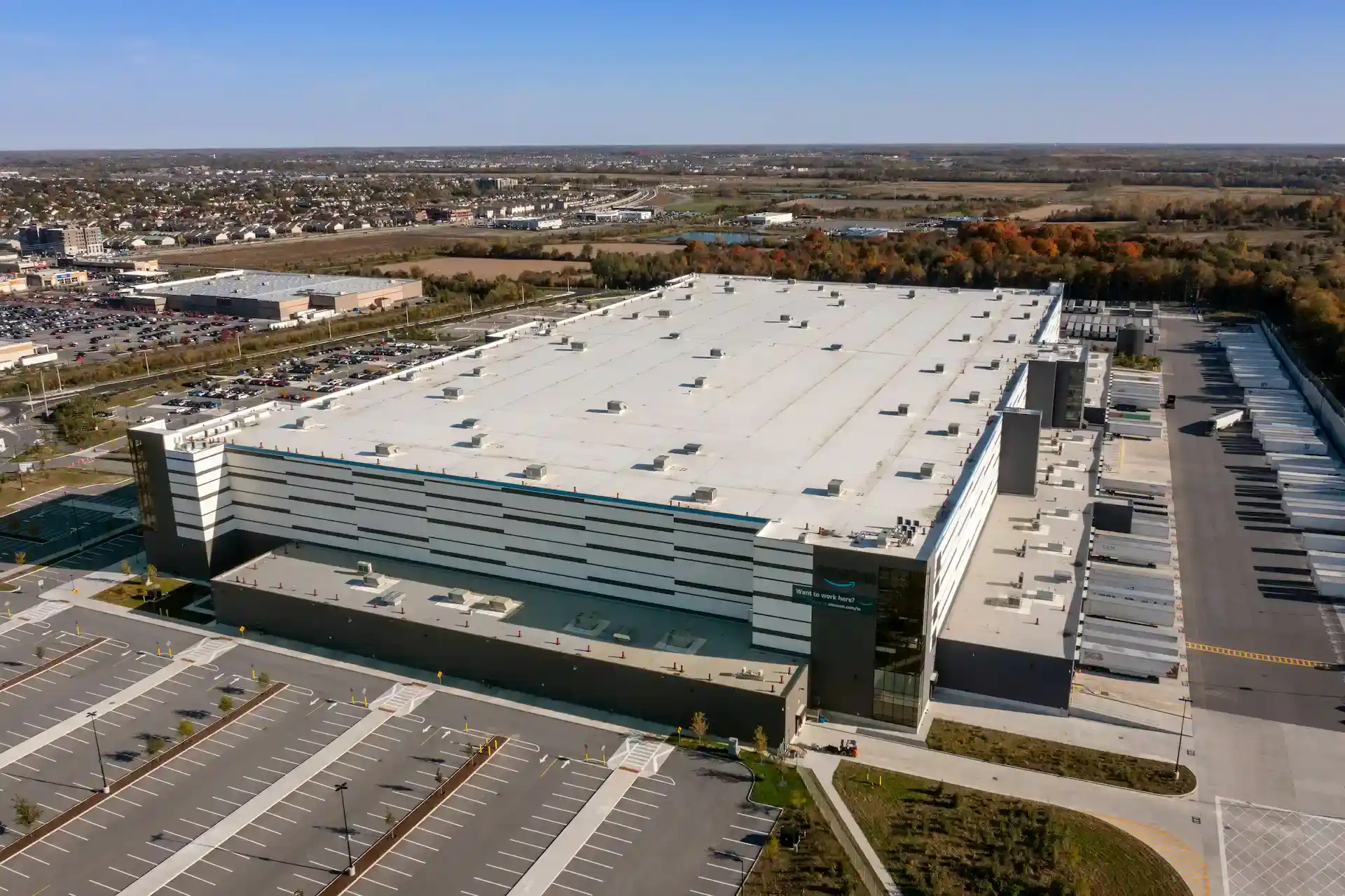
Commercial roofing for warehouses, distribution centers, and industrial storage facilities.
The Amazon Fulfillment Center in Bondurant, east of Des Moines, anchors the central Iowa logistics corridor and represents the kind of large-format industrial roofing challenge that is central to commercial roofing practice in a state that sees genuine four-season extremes. Des Moines endures some of the broadest temperature ranges of any major Midwest market, with summer highs pushing past 95 degrees and winter lows regularly dropping to single digits or below. The roofing system on a Des Moines area warehouse must perform credibly across a 120-degree annual temperature range while managing the state's heavy spring rains and periodic significant snowfall events.
Drainage engineering for Des Moines warehouse footprints requires engineering rather than rule-of-thumb sizing because Iowa's spring rain events combine with snowmelt to create sustained high-volume drainage demands that short-duration sizing methods underestimate. The Iowa Storm Water Design Manual provides the rainfall intensity data appropriate for Polk County, and designers should use the 25-year or 100-year event as the baseline for primary drain sizing on large warehouse footprints. Interior drain locations on very large flat roofs should be spaced to ensure no point on the roof is more than 75 to 100 feet from a drain, reducing the risk of ponding in the shallow-slope areas between drainage zones.
EPDM has historically held the largest market share in Des Moines warehouse roofing due to its proven performance in cold-climate applications, and fully adhered 60-mil EPDM remains a competitive specification for re-cover projects throughout Polk County. However, TPO in white has made significant inroads on new construction over the past decade as Iowa's commercial energy code has tightened and facility managers in climate-controlled distribution centers have quantified the summer cooling cost reductions available from reflective membranes. The decision between EPDM and TPO for a Des Moines warehouse should be driven by a building-specific energy analysis rather than habit or contractor preference.
Dock bay flashing performance during Iowa winters is a genuine concern given the repeated freeze-thaw cycling that Polk County experiences throughout the heating season. The dock doors on large Des Moines distribution centers often face north or west to optimize truck court layouts, and these exposures take the full force of Arctic air masses that move through Iowa from November through March. Counter-flashing above dock leveler bays must be detailed with movement-accommodating sealant joints to survive the differential thermal expansion between the metal wall panel system and the TPO or EPDM membrane termination. Post-winter inspections should always begin at north-facing dock walls where cumulative freeze-thaw damage accumulates fastest.
Rooftop forklift exhaust ventilation is a standard feature on large Des Moines distribution centers that use propane-powered lift equipment indoors. The exhaust penetrations for these systems require curb heights and flashing details that handle winter snow accumulation around the curb base, and the curb-to-membrane termination must be flexible enough to tolerate the significant thermal movement that occurs between Iowa's winter temperature extremes and summer highs. A failed curb flashing in January can admit water into the insulation layer where it freezes, expands, and degrades the underlying deck structure in ways that are costly to repair and difficult to detect without invasive investigation.
Snow load calculation for Des Moines warehouses follows ASCE 7 mapped ground snow load values for Polk County, and the relatively flat terrain of central Iowa produces fairly uniform snow distributions without the complex drift patterns associated with hilly topographies. However, rooftop equipment, stair towers, and parapet height differences do create drift accumulation zones that must be quantified in the structural analysis. Cold-formed metal deck construction common on recent Des Moines warehouse buildings has specific deflection characteristics under snow load that should be reviewed by a structural engineer before adding any significant weight to the roof assembly through insulation upgrades or new equipment.
Energy efficiency for Des Moines warehouses is governed by the Iowa Energy Code, which incorporates ASHRAE 90.1 commercial building requirements. Iowa's relatively favorable electricity rates have historically reduced the urgency of energy code compliance upgrades, but rising energy costs and the aggressive capital reserve planning of large industrial REITs operating in the Bondurant and Ankeny industrial submarkets have driven stronger interest in insulation upgrades at re-roofing. A three-inch polyisocyanurate coverboard added during a TPO re-cover on an under-insulated Des Moines warehouse typically pays back in seven to ten years from energy savings alone, without counting the structural and warranty benefits of the new membrane.
Cost per square foot for full Des Moines warehouse roof replacement runs between $7 and $11, competitive with other Midwest markets and somewhat lower than the high-demand Chicago and Columbus markets nearby. Iowa's qualified commercial roofing contractor base is concentrated in Des Moines and Cedar Rapids, and large projects in the metro area generally attract multiple competitive bids from qualified contractors. Projects in the Bondurant and Altoona industrial parks should be scheduled for fall or spring starts when contractor availability is highest and summer heat has not yet constrained membrane installation hours.
Long-term roof asset management for Des Moines warehouse owners increasingly involves infrared moisture scanning on a five-year cycle to track insulation condition and identify wet areas before they become structural issues. The combination of Des Moines's climate extremes and the large footprints involved means that a wet insulation pocket that goes undetected for a full winter cycle can cause significant deck corrosion or structural fastener degradation. A documented scan program is inexpensive relative to the cost of discovering and repairing hidden structural damage during an emergency roof replacement, and it provides documentation that institutional owners and lenders increasingly expect to see in building condition assessments.
What to send before the roof walk
Send the roof address, leak photos, roof age if known, access instructions, tenant limits, prior reports, and the deadline driving the decision. That lets the first visit focus on the roof condition instead of chasing basic context.
Questions Owners Ask
Can this work happen while the building is occupied?
Often yes. The scope should cover access, safety, dry-in, staging, noise, interior protection, and the times when tenants or operations cannot be interrupted.
What changes the cost most?
Wet insulation, deck condition, edge metal, layer count, access, roof size, code triggers, weather timing, and the amount of repeated damage usually move the cost.
How is the condition documented?
The roof file should include photos, locations, material notes, observed defects, temporary repairs, remaining deficiencies, and recommended next steps.