
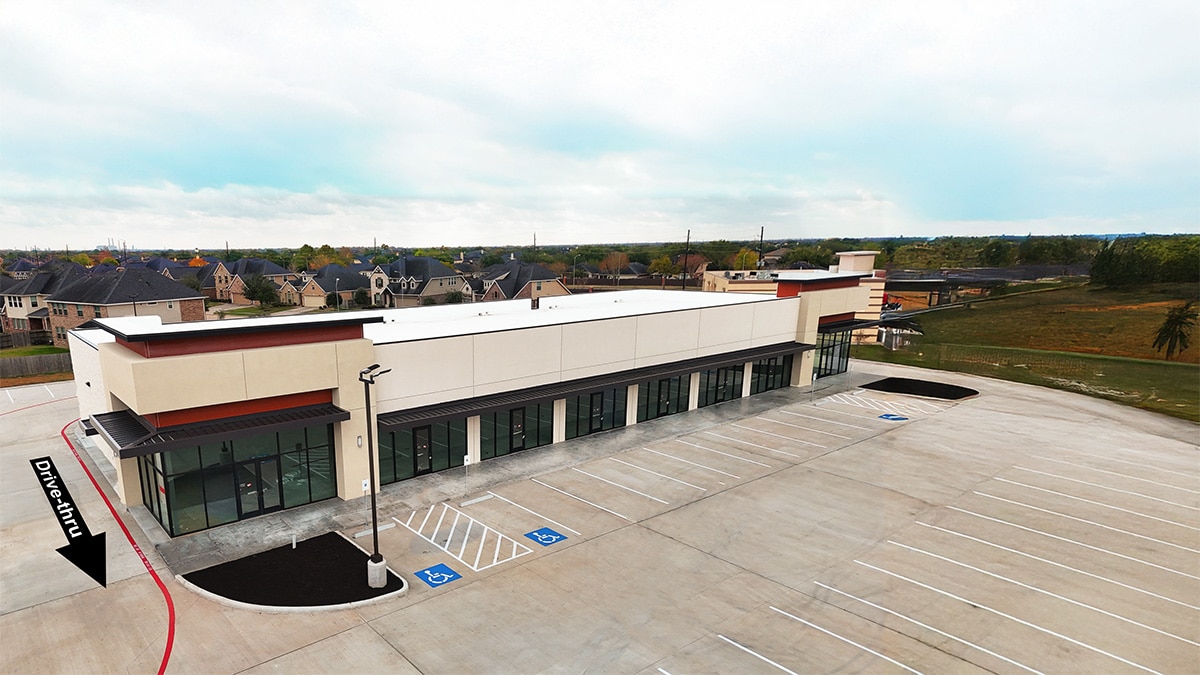
Commercial roofing for retail centers, strip malls, big-box stores, and shopping destinations.
Des Moines has grown into one of the Midwest's most stable retail markets, powered by a financial services economy that sustains strong consumer spending across the metro's retail corridors. From the Jordan Creek Town Center area in West Des Moines to the strip centers along University Avenue, the retail clusters in Ankeny and Waukee, and the neighborhood retail serving established communities in Urbandale and Johnston, the Greater Des Moines retail inventory represents a diverse range of building ages, configurations, and roofing conditions. Iowa's climate, however, doesn't differentiate between a new lifestyle center and a 1985 strip mall, it stresses them all equally with a combination of winter severity, spring flooding risk, and summer hail activity that keeps commercial roofing contractors consistently busy year-round.
Iowa winters are among the most demanding in the continental Midwest for commercial flat roofing. Des Moines averages over 34 inches of snow annually, and that snowpack creates both structural loading demands and the water management challenges that come with freeze-thaw cycling at every penetration, seam, and flashing termination on the roof. Retail properties that enter winter with marginally performing drainage systems or partially compromised membrane seams will typically experience their most significant leak events during the January and February thaw periods, when accumulated ice at parapet scuppers backs water up under flashing edges. Pre-winter roofing inspections and drain maintenance are not discretionary for Des Moines retail landlords, they're the most cost-effective maintenance investment in the calendar year.
Hail damage has become an increasingly significant roofing concern for the Des Moines metro area as severe weather frequency in central Iowa has increased over the past decade. Jordan Creek-area retail centers, the big-box corridors along SE 14th Street, and strip centers throughout Ankeny and Altoona are all exposed to the severe thunderstorm track that moves northeast across the state during May, June, and July. Unlike residential roofing where hail damage is often immediately visible from the ground, commercial flat roof hail damage accumulates as subsurface impact marks on single-ply membranes that can compromise long-term waterproofing performance without triggering visible leaks until months after the storm. Post-storm professional inspections within the carrier's claim window are essential for Des Moines retail property owners.
TPO roofing has become the dominant reroof specification for Des Moines area retail, and the reasoning is straightforward: TPO's heat-welded seam technology and reflective surface address the two biggest performance demands in central Iowa, seam integrity under freeze-thaw stress and energy efficiency during summer months when cooling loads peak in the Metro's retail centers. For anchor stores at community centers in Urbandale and West Des Moines, a properly installed 60-mil TPO system over polyisocyanurate insulation delivers both the thermal performance required by Iowa's energy code and the waterproofing durability needed to survive a decade of Iowa winter cycles without requiring major repairs.
HVAC penetration management is particularly important on Des Moines retail rooftops because of the density of rooftop gas-fired equipment servicing the market's relatively cold climate. Unlike Sun Belt retail where cooling-only equipment predominates, Iowa retail buildings carry rooftop package units that run heating cycles for five or six months per year, driving thermal expansion and contraction at curb flashings and equipment rails through a much wider temperature range. Properly designed curb flashings with appropriate height above the finished roof surface, minimum 8 inches to manage snowdrift accumulation, and flexible sealant at termination bars are critical details that distinguish installation quality in the Iowa market from what might be acceptable in a warmer climate.
Tenant disruption management at Des Moines retail centers requires attention to the specific tenant mix that dominates this market. The financial services economy supports a high concentration of insurance offices, banking branches, and professional service retail throughout the metro's strip centers, tenants whose client-facing operations are directly affected by noise disruptions, parking access limitations, and the appearance of active construction on the building exterior. Roofing contractors working in this environment need to communicate daily work schedules to building managers, coordinate debris removal timing with peak parking hours, and provide written daily work summaries that property managers can share with tenants. The professional tenant base in Des Moines retail holds landlords and their contractors to higher communication standards than some other Midwest markets.
CAM budget planning for retail roofing in Des Moines reflects the market's characteristic combination of stable tenancy and long lease terms. Grocery-anchored centers throughout the metro, from Hy-Vee-anchored developments in Ames and Ankeny to neighborhood centers throughout Clive and Grimes, often carry long-term anchor leases whose CAM provisions were written years ago with different maintenance cost assumptions. Building a defensible roof capital reserve that can survive a tenant CAM challenge requires professional condition assessments, documented repair histories, and a capital forecast that aligns with the anchor lease structure. Des Moines retail landlords who can demonstrate reserve adequacy with third-party documentation are in a substantially stronger position than those managing roof capital informally.
Big-box retail roofing in the Des Moines area presents scale challenges that require specialized contractor capacity. The large anchor stores at Jordan Creek and the freestanding big-box developments along Fleur Drive and SE 14th handle rooftop work on 80,000 to 120,000 square foot roof planes where staging, material handling, and crew coordination are as important as installation skill. A contractor who performs excellently on 15,000 square foot strip center reroof projects may not have the project management infrastructure, the dedicated superintendent capacity, the insulation crane equipment, the QC documentation systems, required to deliver a warranted roofing system on a major anchor store without the defects that come from inadequate oversight at scale.
Retail brand standards influence roofing and rooftop equipment decisions throughout Des Moines' major retail developments in ways that become visible during lease renewal periods and property repositioning projects. When a national tenant at a West Des Moines power center renews and simultaneously upgrades its rooftop mechanical package, the roofing contractor must coordinate with the tenant's facilities team, the mechanical contractor, and the property manager to ensure that new curb locations, equipment screening requirements, and membrane tie-in details are all addressed in a scope that doesn't compromise the existing warranted roof system. That coordination complexity is manageable when it's planned for, it becomes a cost and schedule problem when it's discovered after mobilization.
What to send before the roof walk
Send the roof address, leak photos, roof age if known, access instructions, tenant limits, prior reports, and the deadline driving the decision. That lets the first visit focus on the roof condition instead of chasing basic context.
Questions Owners Ask
Can this work happen while the building is occupied?
Often yes. The scope should cover access, safety, dry-in, staging, noise, interior protection, and the times when tenants or operations cannot be interrupted.
What changes the cost most?
Wet insulation, deck condition, edge metal, layer count, access, roof size, code triggers, weather timing, and the amount of repeated damage usually move the cost.
How is the condition documented?
The roof file should include photos, locations, material notes, observed defects, temporary repairs, remaining deficiencies, and recommended next steps.